Tuesday, June 28, 2011

Industries of the Gulf Islands

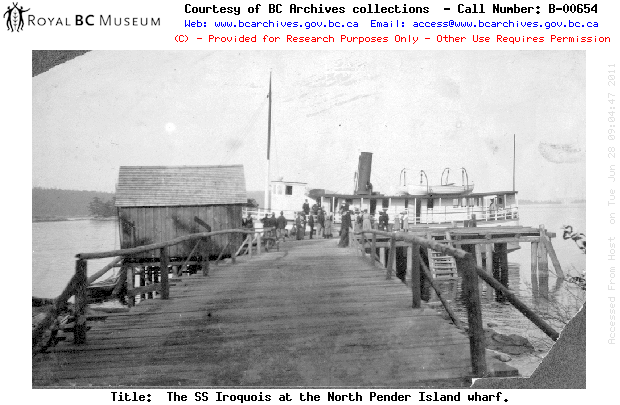
SS Iroquois at Pender Island
In days past, people who lived in the Gulf Islands took whatever work they could find. Almost everyone farmed, hunted, or fished and to round out their income they would log, trap, work at sawmills, fish plants, stone-work or labour at a brick factory. Regular ferry service was not yet a reality, so barges and steam ships would be used to move people and products around the waterways.
The Coast Shale Brick Company was established on North Pender Island in 1912, and didn't last long but some of the bricks are still on the beach of Bricky Bay, to be played with by children. Some of the bricks are in the gardens of islanders, forming walkways and garden walls. Other islands had brick factories also, and Gabriola had one of the longest operating brick factories in the Gulf Islands. The Dominion Shale Brick and Sewer Pipe Company began back in the 1890's and was incorporated in 1911. It produced millions of bricks each year until 1952. The bricks were made of blue and brown shale, plentiful in the Gulf Islands. Shale was dug and blasted out of the hillsides, crushed, ground to a fine powder, mixed with water, and formed into their shapes with hydraulic presses. There was no electricity in the early days in the islands so the factories would use steam pumps and boilers. Bricks would be dried and kiln-fired, cooled down and loaded onto wheelbarrows to be taken to the beaches to load on barges.
Taylor's sandstone quarry on Saturna

Boulder Hotel in Gastown built with Pender Island sandstone
The Gulf Islands were also noted for sandstone. Sandstone was quarried throughout the islands in the mid to late 1800's. The rough-hewn stones from here are in many of the prominent buildings in Vancouver and Victoria, but the demand was reduced in the 1920's and the depression shut down many businesses and factories throughout the region. The earliest sandstone quarry was on Newcastle Island, which supplied the San Francisco US Treasury Mint its dimension blocks in 1873. The BC Penitentiary in 1875, Esquimalt Graving Dock in 1880, Lord Nelson School in 1911 and Christ Church Cathedral in 1955 were built from Newcastle sandstone. Saturna sandstone was primarily quarried at the Taylor farm and the stone there was used for the Carnegie Library in Victoria, Hatley Park House, the Bank of British North America, and the New Westminster Post Office. In 1901 the Boulder Hotel in Gastown used Pender Island sandstone exclusively for its outer walls. One sandstone quarry was at Hope Bay, and another near the bridge between North and South Pender Island, and one or both are the most likely source of the sandstone. The hotel stands today, and sandstone from the islands are in many of the hotels, banks and public buildings that are still in use. The granite and sandstone quarry at the bridge was owned by Mortimer’s Monumental Works Ltd. of Victoria, and the name lives on at Mortimer Spit. Gabriola Island had one of the longest operating sandstone quarries, and the sandstone was also used to produce milling stones that were used in the pulp industry.
Logging was also a primary industry in most Gulf Islands and there are still pockets of old growth trees that give us a glimpse of what the islands used to look like. Trees would be dragged to low bank beaches and towed to the big mills in log booms. Some would be chopped into firewood to fuel the steam ships. The most arable land would have rocks picked, fences built and crops planted. Fruit trees did well in the Gulf Islands, and the location on the main shipping route between Vancouver Island and the mainland was advantageous. People who lived here worked hard and were resourceful and independent, not unlike many of the working islanders today. Many of today's working islanders also are used to working two, maybe three jobs at a time to make ends meet. Some things don't change.
Taylor's sandstone house remnant - now in Gulf Island National Park Reserve on Saturna
Stonework of Taylor house, Saturna
Some of the old industries are still alive, as local craftsmen mill the beams for your house from local trees someone else selectively logged, or build your rock wall from local sandstone. There has been a resurgence in demand for sandstone and granite from the islands. The Hardy Island Granite Quarry which originally operated in the early 1900’s was reopened in 1999. Granite from Hardy Island was used for the steps and paths of the Olympic Village, and new methods of cutting veneers of rock make these building materials easier to work with, more durable and competitive in comparison to the artificial stones.

Thursday, June 16, 2011

Cross-country Tractor Ride to Explore and Share Evolution of Agriculture in Canada

Cross-country Tractor Ride to Explore and Share Evolution of Agriculture in Canada
DULUTH, Ga. (June 14, 2011) — Dr. John Varty, a professor who taught agriculture and environmental history courses through the MacMillan Center at Yale University, is setting out to chronicle how and why agriculture production has changed in Canada as farmers work to meet the demands of an increasing global population. As Varty travels across the country, driving a Massey Ferguson® 1660 compact tractor, he will explore a variety of agriculture-related subjects, from the enduring family farm to the new generation of farmers to food production and land-use changes. The trip will be filmed and the footage used to produce a documentary. Varty will depart June 30 from Atlantic Tractors and Equipment Ltd., the Massey Ferguson dealership in Charlottetown, Prince Edward Island, Canada.


“There have been a fair number of books and documentaries released in recent years that explore how food is produced,” explains Varty. “There are two poles of thought that much of this literature would have us believe. The first is the idea that our food is right on the edge of becoming nonexistent via corporate involvement. And, on the other end of that scale there seems to be this type of white-knight story, where someone is supposed to ride in and save us all. The truth of the matter is that the majority of farmers in Canada are still working out of a family unit, and I want to talk with these farmers to learn more about the challenges they face each day.”
Massey Ferguson, which is sponsoring the tractor ride, has a deep connection to Canadian agriculture, dating back more than 160 years. In 1847, Daniel Massey opened a small workshop to build farm implements in Newcastle, Ontario. Ever since then, Massey Ferguson has been a pioneer in the agriculture equipment industry, developing innovative equipment that farmers count on to help overcome the obstacles and challenges they encounter in the field. And, although a lot has changed in agriculture since 1847, one thing hasn’t: the tremendous pride the Massey Ferguson brand has in its Canadian heritage.
“What Dr. Varty is undertaking is truly a unique project in every sense of the word. Given our Canadian history, it made perfect sense to get involved with this effort,” says Rajesh Joshi, director of marketing at Massey Ferguson. “It’s not every day you hear about an individual who wants to hit the road to connect with farmers to better understand who they are, what they do and how they work. It’s just as much our responsibility as it is anyone else’s in agriculture to help consumers understand how and why the industry has evolved.”
During the tractor ride, Varty will visit more than 20 Massey Ferguson dealerships throughout Prince Edward Island, Nova Scotia, New Brunswick, Quebec and Ontario.
As Varty travels from town to town, he will make additional stops that coincide with local events, such as art festivals, music festivals, theater festivals and sporting events, among others. At each stop, farmers, food company officials, government representatives, community leaders and university professors will be invited to share their respective thoughts and ideas as they relate to food and food production in Canada.
“Our travels will include a hay wagon featuring a small cabin that replicates a 1950s’-style bungalow to provide us shelter and sleeping quarters,” says Varty. “I’ll conduct the majority of my interviews with people in a seating area on the wagon. While we’re going to invite people on board to share their thoughts and ideas, I also envision some creative uses for the wagon as well, such as inviting a local band to use it as a grandstand. I really don’t know what to expect until we depart from Charlottetown. That’s when all of the experiences, interviews and personal stories we’ll use in the documentary will truly begin.”
Additional amenities on the hay wagon include a freshwater tank and solar-generated electricity for lighting and laptop usage.
Varty’s interest in Canadian agricultural history extends beyond the classroom. He has numerous family members who have carried on the family’s five-generation farm in east-central Ontario. The tractor ride will wind through the back roads of Canada, reaching Leamington, Ontario, Canada, by the end of August.
To learn more about Dr. John Varty’s cross-country tractor ride, visit Tractorcanada.com. For more information about Massey Ferguson, and its history in Canada, visithttp://www.masseyferguson.com.
Massey Ferguson® is a worldwide brand of AGCO.

ABOUT AGCO

AGCO, Your Agriculture Company (NYSE:AGCO), was founded in 1990 and offers a full product line of tractors, combines, hay tools, sprayers, forage equipment, tillage implements and related replacement parts. AGCO agricultural products are sold under the core brands of Challenger ®, Fendt®, Massey Ferguson® and Valtra®, and are distributed globally through 2,600 independent dealers and distributors in more than 140 countries worldwide. Retail financing is available through AGCO Finance for qualified purchasers. AGCO is headquartered in Duluth, Ga., USA. In 2010, AGCO had net sales of $6.9 billion.


Author:News on the Net
Seen on: Canada Free Press
Shearing Time in the Gulf Islands

With the warm days of spring comes shearing time for many flocks in the Gulf Islands. Most people arrange for a professional shearer who can quickly remove the fleece in one piece in just minutes. Many islands arrange for the shearer to come over for one or more days to do all of the sheep. Smaller flocks may hold their sheep overnight in a barn so that they are dry and ready to go. Larger flocks will hope for good weather, and will gather the flock into a corral, hopefully with a covered area and handling facility. The weather was good for shearing this year, and the wool looked clean and strong. We remove the dirty tags in a process called "skirting" the fleece, then roll it up and place it in a big burlap sack that is held in place in a tall wooden frame specially built for packing wool. To pack the fleeces tight someone gets on top and stomps the wool down into the bag. Once it is full, we use a large needle to sew the bag tight, label it, and ship it.
Large carding machine, Custom Woolen Mills
The packed wool may go to the Canadian Cooperative Wool Growers (CCWG) where it is sorted, graded, processed and marketed. Sometimes we ship to Custom Woolen Mills in Alberta and have socks, comforters, pillows, blankets and yarn made. This year we made a trip there will a truck full of wool sacks, and were able to bring back a load of pillows and comforters. Some people who have special wool-type sheep may opt to prepare and store each fleece separately and process according to that market so that they can obtain a higher price.
Demand for wool worldwide has been increasing – architects demanding wool carpets, consumers interested in natural fabrics - as the world supply declines, resulting in rising prices for wool. Wool from Canada is primarily exported and China has become a major customer. Last fall, the general manager of CCWG took a wool marketing trip to China and attended an international trade show for wool. He was able negotiate thirteen wool contracts with different woolen mills, representing the sale of 650,000 pounds, or 13 container loads, of wool. He traveled by train and car to the various wool mills and said that Canadian wool was well received. It is a relief to see the prices increasing, given that many sheep producers let their wool become mulch and shearing costs often exceed what the producer can get for their wool. Still, there are many sheep producers who pack their wool for CCWG and make the annual wool drop-off a bit of a social event, hoping that prices will improve.
My brother in law, Graham Rannie, shearing one of our rams when he was last visiting - Alex and Isaac look on
This year the 93rd AGM for the Canadian Cooperative Wool Growers was held in Abbotsford, BC. The CCWG is a sheep producer cooperative with producer shareholders. CCWG is organized to market Canada's wool in the most efficient and profitable way and encourage quality wool production in Canada. The CCWG catalogue is mailed to 20,000 sheep producers in Canada, offering a full range of livestock products, a directory of sheep breeders and shearers, and information. Ken Mallinson is the Director for BC. Among the producers across Canada recognized for their efforts in producing wool, two sets of producers from BC received awards at the AGM. Wayne and Mary Schaad from Black Creek and John and Lorraine Buchanan from Metchosin, all BC Sheep Federation members from Vancouver Island, were the Certificate of Merit winners from BC. These wool growers exemplify the co-operative spirit and were recognized for the extra pride they take in their wool. The recipients of these awards were selected by a panel of judges representing the shearing, warehousing, grading, selling and buying of wool.
My son, Alex, shearing a California Red
Pieter DeMooy shearing one from our commercial flock
Pieter DeMooy from Central Saanich was the shearer for both flocks. Pieter shears many of the flocks in the Gulf Islands and Vancouver Island. He started shearing in 4-H, then went on to shear with the best shearers in New Zealand, Australia and the UK before settling back in Canada and working in the floral industry. He was brought out of shearing-retirement when his good friend and fellow shearer, David Nichols, passed away suddenly. David had been the main shearer for the Gulf Islands for many years, and he had family and friends in the islands. Pieter helped fill the void, both as a shearer and as a friend to many sheep producers who appreciate his skills.


Tuesday, June 14, 2011

News for Sheep Producers in BC

Advance Payment Program now available for Sheep Producers in BC

 The BC Sheep Federation has arranged for the Manitoba Livestock Cash Advance Program to include sheep producers from BC in their Advance Payment Program (APP).  The Advance Payments Program is a federally-funded program that provides producers with a cash advance on the value of their lambs during the growing and finishing phase.  By improving your cash flow throughout the year, the APP helps producers meet their financial obligations and benefit from the best market conditions.  The Manitoba Livestock Cash Advance Program was established in 2007 and is a producer-driven, non-profit organizations representing 10,000 Manitoba producers, mostly in the beef cattle industry.  MLCA also represents sheep producers from Alberta, Saskatchewan and Manitoba – and now BC.  For information on how to apply call 1-866-869-4008 and an application can be mailed or faxed to you. You may also visit their website and download the application at www.manitobalivestock.com.   Financing for sheep may also be available from British Columbia Co-operative Feeder and Bred Heifer Associations in the future. Contact an association near you and the BC Sheep Federation for more information.

Vancouver Island Sheep Producers Receive Certificates of Merit at Canadian Cooperative Wool Grower's AGM

This year the AGM for the Canadian Cooperative Wool Growers was held in Abbotsford BC. Among the producers across Canada recognized for their efforts, two sets of producers from BC, both from Vancouver Island, received  Certificates of Merit. Wayne and Mary Schaad from Black Creek and John and Lorraine Buchanan from Metchosin were the Certificate of Merit winners from BC.   Pieter DeMooy from Central Saanich was the shearer of both flocks.  .
The selection was made by a panel of judges representing the shearing, warehousing, grading, selling and buying aspects of wool. Consideration was given to volume, breeding, care of the fleece, proper preparation and shipment to the Co-op.
BC Sheep Federation surveying farm organizations and sheep producers in the province about the effectiveness of the dog bylaws in their communities.
The BC Sheep Federation will be conducting a scan of regional district and municipal bylaws, as well as seeking input from farm organizations and individual sheep producers, in order to determine the effectiveness of the various dog bylaws in the province. Since the repeal of the Livestock Protection Act in 2003, local governments have had the responsibility of controlling dogs in their communities.  This has been generally in the form of licence tag fees and fines, with some providing compensation to livestock owners who have had livestock killed or injured by stray dogs.  Although the Livestock Protection Act was repealed, the part of the Act allowing livestock owners to shoot and kill dogs chasing or attacking livestock was retained and put into the Livestock Act.  To participate or request more information, please contact Barbara Johnstone Grimmer (250) 629-3817 or firhill@gulfislands.com