Thursday, September 27, 2012
The Rural Blog: New fracking film starring Matt Damon set for release..


Saturday, September 15, 2012
George Ross-Smith 1937-2012
 |
| George on left, with Isaac Grimmer, Martha McMahon and Wally Bradley stooking hay |
Pender Island lost long-time
resident and retired farmer George Ross-Smith on Wednesday, September
5th 2012 at Saanich Peninsula Hospital. George was just
over a month from his 75th birthday, and although his
health had declined in recent years it was still a shock to hear of
his passing.
George Alfred Ross-Smith was born
October 14th, 1937 in Cornwall, Ontario. In 1947 George's
father Ashton bought the big Menzies farm on Pender Island and moved
the family to the farm, a few years before Pender Island had
electricity. George loved the freedom of the farm and the island,
causing a bit of a stir with his brother Ian whenever he could.
George spent many an hour chasing sheep back to the farm in his
childhood, as we all know how sheep ignore fences.
In his teens, George went to
Montreal and became an electrician. He married Marilyn in 1963, and
next year they would have been celebrating their fiftieth wedding
anniversary. In 1965 George and Marilyn and their growing family
moved from Montreal to Pender Island. There was a lot of work for
young people on the island at the time with the new Magic Lake
Estates development. George worked as an electrician on the project,
and he later worked in Vancouver on the construction of the Bentall
Buildings. After that he worked for the Ministry of Transportation,
later with JJM, maintaining the roads of Pender Island.
George was also a farmer. George
raised cattle and sheep, and produced hay on the Ross-Smith Farm for
many years. At first he worked on the road crew full time, and
managed to farm when he could make the time. He often spoke of how
he looked forward to retirement so that he could farm full time. He
especially liked the hay season and would spend many hours on his
tractor, mowing, raking and baling. Many island children had their
farm experience with George, helping lift bales onto the wagon and
getting a good old fashioned hay ride to the big barn at the back of
the farm. He also was a great help to those with small hay fields
and no equipment. George would methodically move his tractor and
equipment to the various acreages to make sure the hay was cut.
George would help out if someone needed thistles cut, or a field
tilled for a market garden. George was more than a farmer, he was a
farmer's farmer. He would help anyone out. He taught newer farmers
various skills. When he wasn't physically able to do the tractor
work anymore, or keep livestock anymore, he allowed other farmers to
cut hay and keep livestock on his farm.
George also took a great interest in
community. George was a member of the Royal Canadian Legion for 52
years. For many years George was a member of the Farmers'
Institute, and he took a special interest in the Fall Fair. George
volunteered as one of Angus McMonnie's assistants for the famous fall
fair barbeque, back to when it first started. Even in later years as
George passed the torch to the younger barbeque cooks, he would still
show up and enjoy helping where he could. When the fair moved to the
current site at the Community Hall next to his farm, George allowed
parking in his hay field for several years, taking the time to mow
the field a second time just before the fair. He helped set up and
take down and enjoyed it very much. But the first year he would not
allow parking there because he said when the Hall was built, there
was not enough parking spaces allotted. Of course, he was right.
That first year the parking was a bit of a disaster as cars went far
and wide up and down roads. George just wanted to prove his point.
George had also written to the Agricultural Land Commission to ensure
that the Hall land remained in the ALR, which it does with the
understanding that the Hall will support agriculture. George was
also supportive of the Community Garden which is located on
Ross-Smith Farm, which he tilled for them when he was physically
able.
There will be a graveside service
at Pender Island Cemetery 12:00 pm Saturday September 15, 2012. A
celebration of life will follow at the Royal Canadian Legion on
Pender Island.
 | |
| George second from right at Fall Fair BBQ, with left to right Aaron Grimmer, Michael Bradley, unknown, Fred Wiercyski , photo by Kelly Irving. |
George was predeceased by his son
Scott. He is survived by his wife Marilyn, son Randall (Soinia)
daughter Catherine, grandsons Geoffrey, Nicholas, Jorden, J. J and
granddaughter Britney. He is also survived by his sister Jean
(Wally) Bradley and brother Ian, and many nieces and nephews. George
was a true island character, an independent soul who had a wide
circle of friends and interests. He will be dearly missed.
Tuesday, August 28, 2012


Tuesday, July 17, 2012
Make hay while the sun shines
 |
| Wally Bradley pitching hay |
Latin
proverb
“As
a third-generation farmer and largest hay producer on the Peninsula,
I can tell you what real farming is. It means surviving in a global
agriculture marketplace.” Bryce Rashleigh, farmer
Farmers
who make hay in the summer start thinking about making hay in the
spring. The grass is growing after a winter’s sleep, and the hay
in the barn is nearly all gone; if you’re lucky you might have a
good reserve to sell your less lucky neighbour who ran out already.
Equipment will be pulled out, greased up, tested and parts replaced.
Maybe the farmer has been to a few early spring farm auctions to pick
up a “nu-to-yu” tractor, mower, rake or baler. When the grass is
ready to shoot ahead in growth, the farmer might spread some
fertilizer on the fields to ensure a good yield. Perhaps a field or
two may be completely renovated, which means tilling, rock picking,
raking, planting, and irrigating.
 |
| the crew |
The
farmer has an eye on the weather at this time, hoping for warm rains
to help the grass grow, and warm stretches of dry sun just at the
time of cutting, curing, raking and baling. Only comedy is more
reliant on timing and perception than farming. Then again, maybe
they are about the same in that respect. Because if you don’t hit
it all just right, nobody is laughing. There is no rest or
celebrating until the last bale is in the barn. Hopefully, none
of it was rained on. Hopefully, none of the equipment broke down in
the process. Once the hay is all in, the farmer should have enough
hay to last six months. Part of having a sustainable farm is being
able to produce and store your own feed for your own livestock so
they can enjoy their own “100 mile diet” year round.
 |
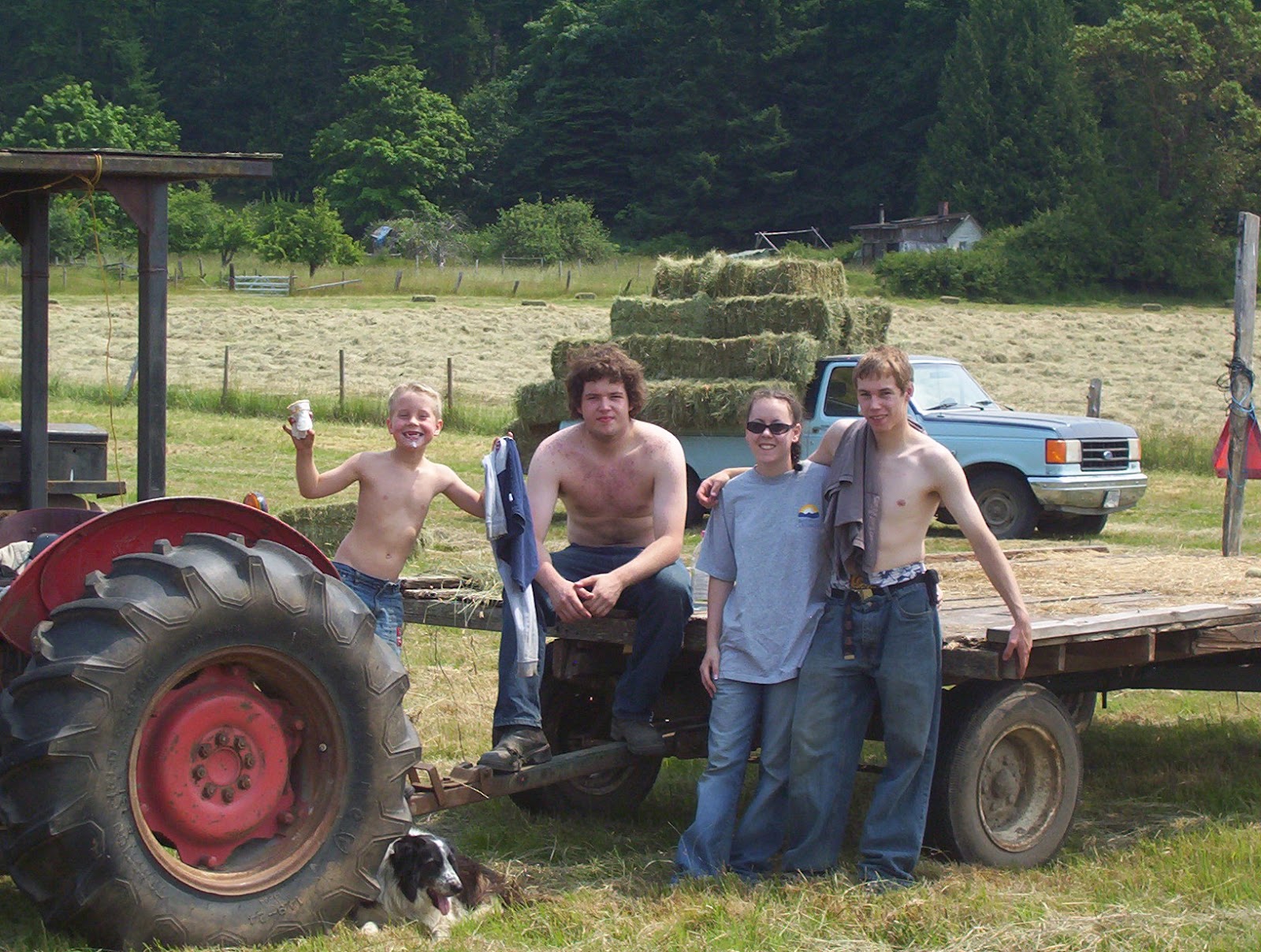
| the whole family pitches in |
All
of this takes a lot of work, and is a central activity of many farms.
So how is it that in the past couple of years I have heard that
producing hay is not really farming? What is a farm and what is
farming? We all know it is a place where food, fibre and perhaps
flowers are grown or raised or produced. Sometimes farms are
subsistent and produce only for the residents of the farm. Sometimes
farms are very productive, supplying food to many people who do not
farm at all. Many types, sizes and definitions. So how is producing
hay not really farming? Perhaps people who think this do not
realize that hay is just one step removed from the beef or lamb on
your plate.
Bryce
Rashleigh of Central Saanich makes a living producing hay on his own
and other’s land. He keeps state of the art equipment, employs
7-10 people a year, and prides himself on being a very good farmer.
He believes that hay farms are keeping the land in farming until the
economics of farming improve. There is good demand for hay in these
parts. Many small farmers do not have the land base or capital to
grow their own hay, so they must buy it from someone who does, or
have someone like Bryce cut their hay for them. Farmers will grow
what they can sell. If you see land in hay and not “food” such
as carrots or beans, think about what might be behind this. Bryce
and many other farmers blame the global supermarket on the cheap food
and labour that Canadian farmers have to compete against. In the
west we have an overabundance of food from all over the world in our
supermarkets. If the consumer bought local food, or requested the
supermarket to source out and carry local produce, there would be the
demand to encourage more local vegetables and fruits to be produced
here. Otherwise, farmers will just keep growing what they can sell.
With predictions that global food production will have to double by
the year 2030 to meet the escalating demand for food, maybe rising
food prices and higher transportation costs will drive up the price
of imported food, making locally produced foods more competitive.
“Farming
looks mighty easy when your plow is a pencil and you're a thousand
miles from the corn field.”
Dwight
D. Eisenhower
Tuesday, July 3, 2012
"Tired" - photo by Kelly Hofer, ex-Hutterite, and story on my visit to a Hutterite farm
I was in Alberta for a sheep meeting a while back, and since we made a family visit/road trip out of it, it seemed a good time and place to look around for Border Collies. One of the ads we called said he had just the dog for me, so out we went.
The farm was a huge grain and livestock operation on 6,000 acres, with several barns and buildings, and what looked like an apartment complex. There was no farm sign, no clear indication that this was anything but a big ubiquitous Alberta farm. The fellow with the dogs answered our questions, and then seemed quite pleased to grant our request for a short tour. We all went across the road to the main farm complex, and immediately it became apparent that this was a Hutterite farm. All the men were dressed in black, even the boys. No women were in sight. The children quickly swarmed around our vehicle, as curious about us as we were about them.
Since it was winter, the tour started with their main workplace – the shop. They first showed us their woodworking shop. Then they showed us their pride and joy - a high tech computerized metal fabricating shop to make customized attachments for Bobcats. Many Hutterite colonies have diversified into manufacturing, some have developed value-added farm products, like pancake mixes or wool comforters. The needs to keep men working year round and contributing to the colony as they have adapted farming technologies that reduce labour requirements, and the need for capital to expand their operations, are the drivers behind the diversification into manufacturing.
After the tour of the workshops, we got into a big farm truck to go feed the cattle. The cattle were sleek and healthy, and were fed a chopped mix of grain and forage. We noticed the absence of a radio in the truck. The influences of the outside world are minimized here, yet they still are on the fore front of any technologies that could enhance their farm.
The colony also had a large layer operation. We entered the layer barn at the egg handling area. The eggs came in by conveyer belts, automatically picking up the eggs as they were laid and delivering them to be graded, sorted, washed, packed then put into a cooler. The packing area was tiled from floor to ceiling and very clean. We weren’t allowed into the layer barn, but could see inside where the chickens were. The colony also had pigs and meat chickens, and produced all of their own grain, hay and straw. They also had a large garden to produce vegetables for the colony.
After I got home I researched Hutterites on the internet, and was particularly impressed by a Flickr site called the “Shutterite”, a young Hutterite’s photos of his colony and their work. Not long after I was looking at the photos, the site became closed to visitors or shut down, and I wondered what happened to the brilliant photographer. Then I opened my Western Producer last week and there were the unmistakable images of Kelly Hofer, laid out in full colour splendour in the center of the widely read farm paper. The article about him mentioned that although his photos have shown his colony in a good light, the religious leaders are not comfortable with the attention this has brought Kelly. Individualism is not encouraged in a Hutterite colony, where everyone works for the good of the group. I was further pleased to see one of Kelly Hofer’s photos on the front page of the National Post only a week after the Western Producer feature. The photo was of a Hutterite girl in traditional dress, sitting in the rim of an enormous tractor tire out in a big farm field. The article that went with it was about Kelly and his life as a Hutterite photographer, and the struggle the Hutterites face balancing adoption of modern technology and adherence to traditional communal values. The article went on to say that Kelly had decided to leave the colony, a personal decision to pursue his gift.
Whatever people may say about the Hutterite culture, they are among the most successful, productive, innovative farmers in Canada and the US. Hutterites came to North America in the 1800's, encouraged by the promise of religious freedom and the opportunity to grow their pacifist communities. They have somehow managed to blend their old-style communal traditions and strong work ethic with state of the art farm technology, easily adopting cooperative agricultural management and economies of scale to achieve a level of success non-Hutterites sometimes resent. Their colonies are self-contained, with their own schools, churches, abattoirs and all the services a small community would need. They have a communal structure where all assets are shared, none are individually owned, and their traditions are deeply ingrained and rigid.
 Since 1949 when the first colony came to Saskatchewan, they expanded their land holdings to over 2% of all agricultural land in that province, over half a million acres, by 1993. In 2009, Hutterites owned over 40% of all hogs in Manitoba, and over a third of all hogs in Alberta, even though they represented less than 10% of the operations. In South Dakota, Hutterites raise 50-60% of the hogs, in Montana, 90%. Colonies in Montana also produce 98% of the eggs using state-of-the-art equipment. In BC, colonies are in the Peace River area, many raising sheep, cattle and grain.
These aren’t what some would call family farms, but they are.

The farm was a huge grain and livestock operation on 6,000 acres, with several barns and buildings, and what looked like an apartment complex. There was no farm sign, no clear indication that this was anything but a big ubiquitous Alberta farm. The fellow with the dogs answered our questions, and then seemed quite pleased to grant our request for a short tour. We all went across the road to the main farm complex, and immediately it became apparent that this was a Hutterite farm. All the men were dressed in black, even the boys. No women were in sight. The children quickly swarmed around our vehicle, as curious about us as we were about them.
Since it was winter, the tour started with their main workplace – the shop. They first showed us their woodworking shop. Then they showed us their pride and joy - a high tech computerized metal fabricating shop to make customized attachments for Bobcats. Many Hutterite colonies have diversified into manufacturing, some have developed value-added farm products, like pancake mixes or wool comforters. The needs to keep men working year round and contributing to the colony as they have adapted farming technologies that reduce labour requirements, and the need for capital to expand their operations, are the drivers behind the diversification into manufacturing.
After the tour of the workshops, we got into a big farm truck to go feed the cattle. The cattle were sleek and healthy, and were fed a chopped mix of grain and forage. We noticed the absence of a radio in the truck. The influences of the outside world are minimized here, yet they still are on the fore front of any technologies that could enhance their farm.
The colony also had a large layer operation. We entered the layer barn at the egg handling area. The eggs came in by conveyer belts, automatically picking up the eggs as they were laid and delivering them to be graded, sorted, washed, packed then put into a cooler. The packing area was tiled from floor to ceiling and very clean. We weren’t allowed into the layer barn, but could see inside where the chickens were. The colony also had pigs and meat chickens, and produced all of their own grain, hay and straw. They also had a large garden to produce vegetables for the colony.
After I got home I researched Hutterites on the internet, and was particularly impressed by a Flickr site called the “Shutterite”, a young Hutterite’s photos of his colony and their work. Not long after I was looking at the photos, the site became closed to visitors or shut down, and I wondered what happened to the brilliant photographer. Then I opened my Western Producer last week and there were the unmistakable images of Kelly Hofer, laid out in full colour splendour in the center of the widely read farm paper. The article about him mentioned that although his photos have shown his colony in a good light, the religious leaders are not comfortable with the attention this has brought Kelly. Individualism is not encouraged in a Hutterite colony, where everyone works for the good of the group. I was further pleased to see one of Kelly Hofer’s photos on the front page of the National Post only a week after the Western Producer feature. The photo was of a Hutterite girl in traditional dress, sitting in the rim of an enormous tractor tire out in a big farm field. The article that went with it was about Kelly and his life as a Hutterite photographer, and the struggle the Hutterites face balancing adoption of modern technology and adherence to traditional communal values. The article went on to say that Kelly had decided to leave the colony, a personal decision to pursue his gift.
Whatever people may say about the Hutterite culture, they are among the most successful, productive, innovative farmers in Canada and the US. Hutterites came to North America in the 1800's, encouraged by the promise of religious freedom and the opportunity to grow their pacifist communities. They have somehow managed to blend their old-style communal traditions and strong work ethic with state of the art farm technology, easily adopting cooperative agricultural management and economies of scale to achieve a level of success non-Hutterites sometimes resent. Their colonies are self-contained, with their own schools, churches, abattoirs and all the services a small community would need. They have a communal structure where all assets are shared, none are individually owned, and their traditions are deeply ingrained and rigid.

These aren’t what some would call family farms, but they are.
Hutterite Farms

I was in
Alberta for a sheep meeting a while back, and since we made a family
visit/road trip out of it, it seemed a good time and place to look
around for Border Collies. One of the ads we called said he had just
the dog for me, so out we went.
The farm was a
huge grain and livestock operation on 6,000 acres, with several barns
and buildings, and what looked like an apartment complex. There was
no farm sign, no clear indication that this was anything but a big
ubiquitous Alberta farm. The fellow with the dogs answered our
questions, and then seemed quite pleased to grant our request for a
short tour. We all went across the road to the main farm complex,
and immediately it became apparent that this was a Hutterite farm.
All the men were dressed in black, even the boys. No women were in
sight. The children quickly swarmed around our vehicle, as curious
about us as we were about them.
Since it was
winter, the tour started with their main workplace – the shop.
They first showed us their woodworking shop. Then they showed us
their pride and joy - a high tech computerized metal fabricating shop
to make customized attachments for Bobcats. Many Hutterite colonies
have diversified into manufacturing, some have developed value-added
farm products, like pancake mixes or wool comforters. The needs to
keep men working year round and contributing to the colony as they
have adapted farming technologies that reduce labour requirements,
and the need for capital to expand their operations, are the drivers
behind the diversification into manufacturing.
After the tour
of the workshops, we got into a big farm truck to go feed the cattle.
The cattle were sleek and healthy, and were fed a chopped mix of
grain and forage. We noticed the absence of a radio in the truck.
The influences of the outside world are minimized here, yet they
still are on the fore front of any technologies that could enhance
their farm.
The colony also
had a large layer operation. We entered the layer barn at the egg
handling area. The eggs came in by conveyer belts, automatically
picking up the eggs as they were laid and delivering them to be
graded, sorted, washed, packed then put into a cooler. The packing
area was tiled from floor to ceiling and very clean. We weren’t
allowed into the layer barn, but could see inside where the chickens
were. The colony also had pigs and meat chickens, and produced all
of their own grain, hay and straw. They also had a large garden to
produce vegetables for the colony.
 |
| Tired, a photo by Kelly Hofer on Flickr |
Whatever people
may say about the Hutterite culture, they are among the most
successful, productive, innovative farmers in Canada and the US.
Hutterites came to North America in the 1800's, encouraged by the
promise of religious freedom and the opportunity to grow their
pacifist communities. They have somehow managed to blend their
old-style communal traditions and strong work ethic with state of the
art farm technology, easily adopting cooperative agricultural
management and economies of scale to achieve a level of success
non-Hutterites sometimes resent. Their colonies are self-contained,
with their own schools, churches, abattoirs and all the services a
small community would need. They have a communal structure where all
assets are shared, none are individually owned, and their traditions
are deeply ingrained and rigid.
Since 1949 when
the first colony came to Saskatchewan, they expanded their land
holdings to over 2% of all agricultural land in that province, over
half a million acres, by 1993. In 2009, Hutterites owned over 40% of
all hogs in Manitoba, and over a third of all hogs in Alberta, even
though they represented less than 10% of the operations. In South
Dakota, Hutterites raise 50-60% of the hogs, in Montana, 90%.
Colonies in Montana also produce 98% of the eggs using
state-of-the-art equipment. In BC, colonies are in the Peace River
area, many raising sheep, cattle and grain.
These
aren’t what some would call family farms, but they are.
Tuesday, June 19, 2012
In remembrance of John Wilcox
“Our
imperative now lies not in how to grow this or how to market that.
What’s critical is a rebirth of BC farm Leadership. In BC, only one
half of one percent of the province still farms, and our provincial
government spending on agriculture, by percentage of GDP, is the
lowest in Canada. We need new mortgage systems to enable investment
in farmland. Using the Agricultural Land Reserve to grow our own food
will never happen without such enabled investment – and such
investment requires leadership.”
John
Wilcox, Salt Spring Island farmer, farm leader and farm writer

Active
is perhaps an understatement. In a notice to all District "A" Farmers’
Institute members, Jenny McLeod, Secretary of District A said “He
WAS District "A" Farmers’ Institute and our resident historian. He
gave his all for farmers and farming and gave a voice to small scale
farmers throughout BC. He was a founder of FARM Community Council
and a real contributor to agriculture in BC.”
John
also had interests beyond our borders and was at the forefront of
many initiatives. As a new graduate in 1961, he went to rural India
as an agricultural volunteer and became a founding member of Canadian
Volunteers Overseas, now Canadian University Students Overseas
(CUSO). His current positions included membership in BC Farm Writers
Association, Island Natural Growers and Salt Spring Island Chamber of
Commerce. John was also a Conservation Partner with The Land
Conservancy of BC. In 2007 John received a Life Time Achievement
Award for Dedicated Service to Community Agriculture and District “A”
Farmers Institute for his many years serving on boards for Islands
Farmers Institute, Island Natural Growers, District "A" Farmers’
Institute, BC Federation of Agriculture, FARM Community Council,
Investment Agriculture and the BC Agriculture Council.
His
crowning achievement was Duck Creek Farm, an organic market garden
and biodiverse conservation area. He had to work hard, for many
years, to earn the money to buy and develop the land into a viable,
productive farm and home. His success as a farmer was recognized
by the business community, as he was awarded the first ever Salt
Spring Island Chamber of Commerce Home Based Business Award in 2006,
and the Agricultural/Farm Business of the Year Award in 2011.
For
years John Wilcox wrote pearls of wisdom in his “Barn Side”
column, prominently featured with his infectious smile on the
editorial pages of the widely-read farm paper, Country Life in BC.
His columns dissected government policies and actions, presented
opinions and ideas, in essence not just thinking out loud but talking
(or shouting) out loud to anyone who would listen. His style was all
his own. The farmer-activist, who used his pen as his weapon, or
tool, was vital in communicating to policy makers, other farmers and
the public. His personal
frustrations with the ever-growing counterproductive bureaucracies
became the catalyst for his activism and his actions. His early
working life included government positions in both Ontario and BC in
the golden years of extension services for farmers, so he had a good
idea of what farmers needed, and what government could provide.
John
was also known as “Johnny Canuck”, for his anti-Free Trade
mission in 1988 highlighted by a cross-Canada round trip in a 1941
maple leaf-painted Chevy. It is so appropriate that his life will be
celebrated on Canada Day, July 1st,
at Fulford Hall, starting at 3 pm.
John
is survived by his brother, Jim Wilcox, daughter Lisa Wilcox, first
wife Judith Stuart, daughters Samantha Wilcox and Emma Rubatscher
(Jon), second wife Lynda Wilcox, stepson Dan Brooke (Erica),
granddaughter Megan Brooke, partner Sue Earle, stepson Eland
Bronstein and daughter Ella Bronstein.
Subscribe to:
Posts (Atom)