Monday, October 22, 2012
Where have the bullfrogs gone?
Where have the bullfrogs gone? Late in the spring I would hear
bullfrogs plopping into our ponds as I walked the water's edge. Then
summer came and poof - no bullfrogs. No deep throaty noises at night.
Some people spotted the odd frog dead by the road. But what happened to the invasion? On our farm, something made them go away. And we didn't
do anything to remove or kill them.


Balancing Beavers
_1988.jpg)
When beavers first
showed up in our pond, we had mixed reactions. I thought it would be
great to have nature’s engineers maintaining our pond water levels,
adding to a balanced ecosystem. And hey, they are Canada’s national
animal and pretty interesting. My husband’s reaction was less than
enthusiastic. “Oh no,” he said. “They will take out the trees
and cause all kinds of damage.” We were both right. For a while
the busy beavers worked nightly to plug holes in the pond and raise
the water level. But the destruction – plugging the overflow
drain, dropping trees around the pond, even a large cedar at the
fence line. Trees landed across fences, resulting in the escape of
several sheep. There were simply too many trees in too large an area
to save by wrapping with chicken wire. After a few years the
parents turfed out the eldest children in their clan, at first by
punching a hole in the pond to create a new neighbouring pond. This
just succeeded in flooding the neighbour’s field. So the kids
moved on to the golf course, and were seen late at night waddling
down the road.
Besides the damage we
can all see, there is the microscopic damage caused by the organisms
they carry. “Beaver fever” caused by Giardia is a common
occurrence when beavers move their homes into open drinking water
systems. This organism causes severe gastric distress and diarrhoea
and is no laughing matter to those affected. One of my sons
contracted Giardia from playing on a river bank when were in
California. He had severe diarrhoea for a year, even after diagnosis
and treatment. Beavers can also carry E. coli and Salmonella. Even
though we do not drink from this pond, we worried that such organisms
would affect our garden’s irrigation water which came from this
pond. When the damage and health risk from beavers are weighed
against their benefits, it may become necessary to remove the
beavers permanently from a water body.
The CRD enlisted the
help of a licenced trapper, trained in the Malaspina College (now
Vancouver Island University) Resource Management diploma program to
remove the beavers from a water system on Saturna Island. Private
property owners who use ponds as drinking water systems have also
used the same trapper to successfully remove beavers. It is
important that people have the proper training, permits and licenses
in place when they attempt to remove beavers from an area.
At one time beavers
were found in most ponds and lakes in the Gulf Islands. In fact,
they probably built most of the ponds years ago. They would build
dams which would hold water, flooding the land behind the dam,
creating a wetland area rich with life. The Hudson’s Bay Company
had a base on San Juan Island and proceeded to trap all the beavers
in the area for their pelts. In recent years, as farmers have been
digging ponds for irrigation, developments building their own
human-made dams for drinking water and predators (except for man)
absent the stage is set for beaver numbers to increase. There is
little interest in trapping them for their pelts these days, at least
around these parts. Their introduction is believed to be via
driftwood logs and log booms, but introduction by humans cannot be
ruled out entirely.
As beavers become
re-established throughout the Gulf and San Juan Islands there will no
doubt be conflicts between people who see only the cute Canadian
symbol on the nickel, the master builders who engineer ecosystems
that suit their needs and enhance wetlands, and those who are
concerned about the health and safety risks and the unwanted damage
and flooding that can occur. There will be a need to understand
these animals and balance their presence, often called “the most
destructive creatures next to man”.
Tuesday, October 9, 2012
Why you don't put all your eggs in one basket - E. coli and XL Foods
 |
| Campbell Farm abattoir - CFIA inspected |
A
few days ago I went to Saturna Island to pick up one of my lambs that
was being processed at Campbell Farm's abattoir. The lamb was for a
special local food event, a Farms Dinner at Poets Cove Resort on
Pender Island, profiling many of Pender Islands' farms and food
producers. While I was there, I picked up three boxes of beef from
Campbell farm, labelled with the beef's name “Flippers”. I know
that Flippers had to just walk down the valley to be slaughtered in a
clean, calm environment. I know the CFIA inspector was on site to
supervise each step of the process; first, to ensure the animal was
healthy, second, to ensure that it was killed humanely. The
inspector would then focus on the cleanliness of the entire operation
and process, from the hide removal, to the removal of the internal
organs, the inspection of the internal organs, and a close visual
inspection of the carcass with a final wash using clean water, tested
for purity. Only then does the inspector put the government stamp on
the meat, just before it is put into the cooler. After chilling for
several days, the meat would be cut and wrapped and ready to prepare.
Jacques
Campbell and I talked about the importance of a local food system
like this one. Small scale and local, completely traceable to the
source. Each animal processed individually. An inspection system
that is looking out for the health of the public.
 |
| XL Foods Inc. plant - CFIA inspected |
So
what went wrong at the XL plant, and why did it go wrong? XL Foods
Inc. is the largest Canadian owned and operated beef processor. One
would expect that such a plant, federally inspected by the Canadian
Food Inspection Agency (CFIA), shipping meat far and wide, would have
extra scrutiny upon it. Since the identification of E. coli 0157
back in the 80's, much has been learned about the organism. It is
known that many animals carry the organism. Cattle who carry the
bacteria do not show any symptoms of disease, and some animals can
shed huge amounts of the bacteria in their feces. It is known that
the organism spreads easily from animal to animal, and feedlots with
their high animal densities and high grain diets have the highest
proportion of infected animals. Even so, the rate of infection
within feedlot pens can vary widely. Infections come and go with
animals, and most infections are temporary, lasting about four weeks.
Some beef can be super-shedders, and some believe all it would take
is one or two super-shedders, some sloppy slaughtering and less than
perfect conditions for the meat to become infected in a plant such as
XL.
 |
| Econiche, vaccine developed by Brett Finlay's team at UBC |
Given
these facts, a research team led by Brett Finlay, a UBC microbiologist at the Michael Smith Laboratories, developed a vaccine
to E. coli 0157:H7 for use in cattle that can significantly reduce
the amount of bacteria shed, in order to protect public health.
The vaccine “Econiche” is licensed by Bioniche Life Sciences Inc.
Rick Culbert, President of Bioniche Food Safety, describes the
vaccine as “the world's first fully licensed vaccine for use in
cattle to reduce shedding of E. coli 0157”. He said “there are a
few producers (both beef and dairy) that have faithfully been using
the vaccine. These producers do so because they believe it is the
right thing to do.” Because of the lack of symptoms in cattle, and
the lack of negative impact on productivity, the vaccine is perhaps
seen more as an added expense. “As the majority of cattlemen are
commodity oriented, with resistance to input costs, the product over
all has less than 5% market penetration.” Mr. Culbert adds that
most enquiries into the vaccine following the XL outbreak have been
by consumers and media, not by cattle producers. “I suppose that
is appropriate in that the vaccine is not for the benefit of the
cattle. It is for the benefit of the consumer – by reducing the
risk of E. coli 0157 exposure.” In Bioniche's recent annual
report, President Graham McRae said “ sales of our E. coli 0157
vaccine – Econiche – have been limited to date as there is
presently no mandatory requirement for cattlemen in Canada to
vaccinate their animals, nor do they receive any compensation or
incentive to do so.”
Some
of the cattle producers that are using the vaccine are those that
show cattle, and don't want to risk their animals contracting the
disease on the show circuit, or passing on any such bacteria to the
public at the fairs. Other users are often special label beef, that
can use the reduction or absence of the E. coli 0157 as a marketing
feature for public safety. Many producers, and especially feedlot
operators, have an interest in using the vaccine but would like to
see research trial results and work done to reduce the number of
injections from three to two. Some are looking forward to trials
that are testing probiotics that can perhaps compete with E. coli
0157.
And
then there is the simple observation made several years ago that a
forage-based diet of grass and hay will reduce the shedding of the
bacteria. Even so, E. coli 0157 is so infectious in humans that it
does not take very many bacteria to cause an infection. Even with
reduced numbers at the animal level, there still needs to be good
slaughter practices of meat. Enormous plants with fast lines and minimal inspection practices are the last thing we need to have safemeat.
A
recent press release by XL outlines a plan that should significantly
reduce such incidents in the future. It includes holding all
carcasses until test results are completed. That should have been
the standard in a plant as large as this all along, knowing that it
was a matter of time before the system failed. And the CFIA should
not be off the hook and pointing fingers. There is no reason why a
CFIA inspector at the plant could not have stopped the line or
ordered that procedures be changed as soon as deficiencies were
noted. Small plants, like Jacques Campbell's, are under such CFIA
scrutiny every time they slaughter. Why not the big federal plants?
Local food just looks better and better.
Thursday, September 27, 2012
The Rural Blog: New fracking film starring Matt Damon set for release..
Saturday, September 15, 2012
George Ross-Smith 1937-2012
 |
| George on left, with Isaac Grimmer, Martha McMahon and Wally Bradley stooking hay |
Pender Island lost long-time
resident and retired farmer George Ross-Smith on Wednesday, September
5th 2012 at Saanich Peninsula Hospital. George was just
over a month from his 75th birthday, and although his
health had declined in recent years it was still a shock to hear of
his passing.
George Alfred Ross-Smith was born
October 14th, 1937 in Cornwall, Ontario. In 1947 George's
father Ashton bought the big Menzies farm on Pender Island and moved
the family to the farm, a few years before Pender Island had
electricity. George loved the freedom of the farm and the island,
causing a bit of a stir with his brother Ian whenever he could.
George spent many an hour chasing sheep back to the farm in his
childhood, as we all know how sheep ignore fences.
In his teens, George went to
Montreal and became an electrician. He married Marilyn in 1963, and
next year they would have been celebrating their fiftieth wedding
anniversary. In 1965 George and Marilyn and their growing family
moved from Montreal to Pender Island. There was a lot of work for
young people on the island at the time with the new Magic Lake
Estates development. George worked as an electrician on the project,
and he later worked in Vancouver on the construction of the Bentall
Buildings. After that he worked for the Ministry of Transportation,
later with JJM, maintaining the roads of Pender Island.
George was also a farmer. George
raised cattle and sheep, and produced hay on the Ross-Smith Farm for
many years. At first he worked on the road crew full time, and
managed to farm when he could make the time. He often spoke of how
he looked forward to retirement so that he could farm full time. He
especially liked the hay season and would spend many hours on his
tractor, mowing, raking and baling. Many island children had their
farm experience with George, helping lift bales onto the wagon and
getting a good old fashioned hay ride to the big barn at the back of
the farm. He also was a great help to those with small hay fields
and no equipment. George would methodically move his tractor and
equipment to the various acreages to make sure the hay was cut.
George would help out if someone needed thistles cut, or a field
tilled for a market garden. George was more than a farmer, he was a
farmer's farmer. He would help anyone out. He taught newer farmers
various skills. When he wasn't physically able to do the tractor
work anymore, or keep livestock anymore, he allowed other farmers to
cut hay and keep livestock on his farm.
George also took a great interest in
community. George was a member of the Royal Canadian Legion for 52
years. For many years George was a member of the Farmers'
Institute, and he took a special interest in the Fall Fair. George
volunteered as one of Angus McMonnie's assistants for the famous fall
fair barbeque, back to when it first started. Even in later years as
George passed the torch to the younger barbeque cooks, he would still
show up and enjoy helping where he could. When the fair moved to the
current site at the Community Hall next to his farm, George allowed
parking in his hay field for several years, taking the time to mow
the field a second time just before the fair. He helped set up and
take down and enjoyed it very much. But the first year he would not
allow parking there because he said when the Hall was built, there
was not enough parking spaces allotted. Of course, he was right.
That first year the parking was a bit of a disaster as cars went far
and wide up and down roads. George just wanted to prove his point.
George had also written to the Agricultural Land Commission to ensure
that the Hall land remained in the ALR, which it does with the
understanding that the Hall will support agriculture. George was
also supportive of the Community Garden which is located on
Ross-Smith Farm, which he tilled for them when he was physically
able.
There will be a graveside service
at Pender Island Cemetery 12:00 pm Saturday September 15, 2012. A
celebration of life will follow at the Royal Canadian Legion on
Pender Island.
 | |
| George second from right at Fall Fair BBQ, with left to right Aaron Grimmer, Michael Bradley, unknown, Fred Wiercyski , photo by Kelly Irving. |
George was predeceased by his son
Scott. He is survived by his wife Marilyn, son Randall (Soinia)
daughter Catherine, grandsons Geoffrey, Nicholas, Jorden, J. J and
granddaughter Britney. He is also survived by his sister Jean
(Wally) Bradley and brother Ian, and many nieces and nephews. George
was a true island character, an independent soul who had a wide
circle of friends and interests. He will be dearly missed.
Tuesday, August 28, 2012


Tuesday, July 17, 2012
Make hay while the sun shines
 |
| Wally Bradley pitching hay |
Latin
proverb
“As
a third-generation farmer and largest hay producer on the Peninsula,
I can tell you what real farming is. It means surviving in a global
agriculture marketplace.” Bryce Rashleigh, farmer
Farmers
who make hay in the summer start thinking about making hay in the
spring. The grass is growing after a winter’s sleep, and the hay
in the barn is nearly all gone; if you’re lucky you might have a
good reserve to sell your less lucky neighbour who ran out already.
Equipment will be pulled out, greased up, tested and parts replaced.
Maybe the farmer has been to a few early spring farm auctions to pick
up a “nu-to-yu” tractor, mower, rake or baler. When the grass is
ready to shoot ahead in growth, the farmer might spread some
fertilizer on the fields to ensure a good yield. Perhaps a field or
two may be completely renovated, which means tilling, rock picking,
raking, planting, and irrigating.
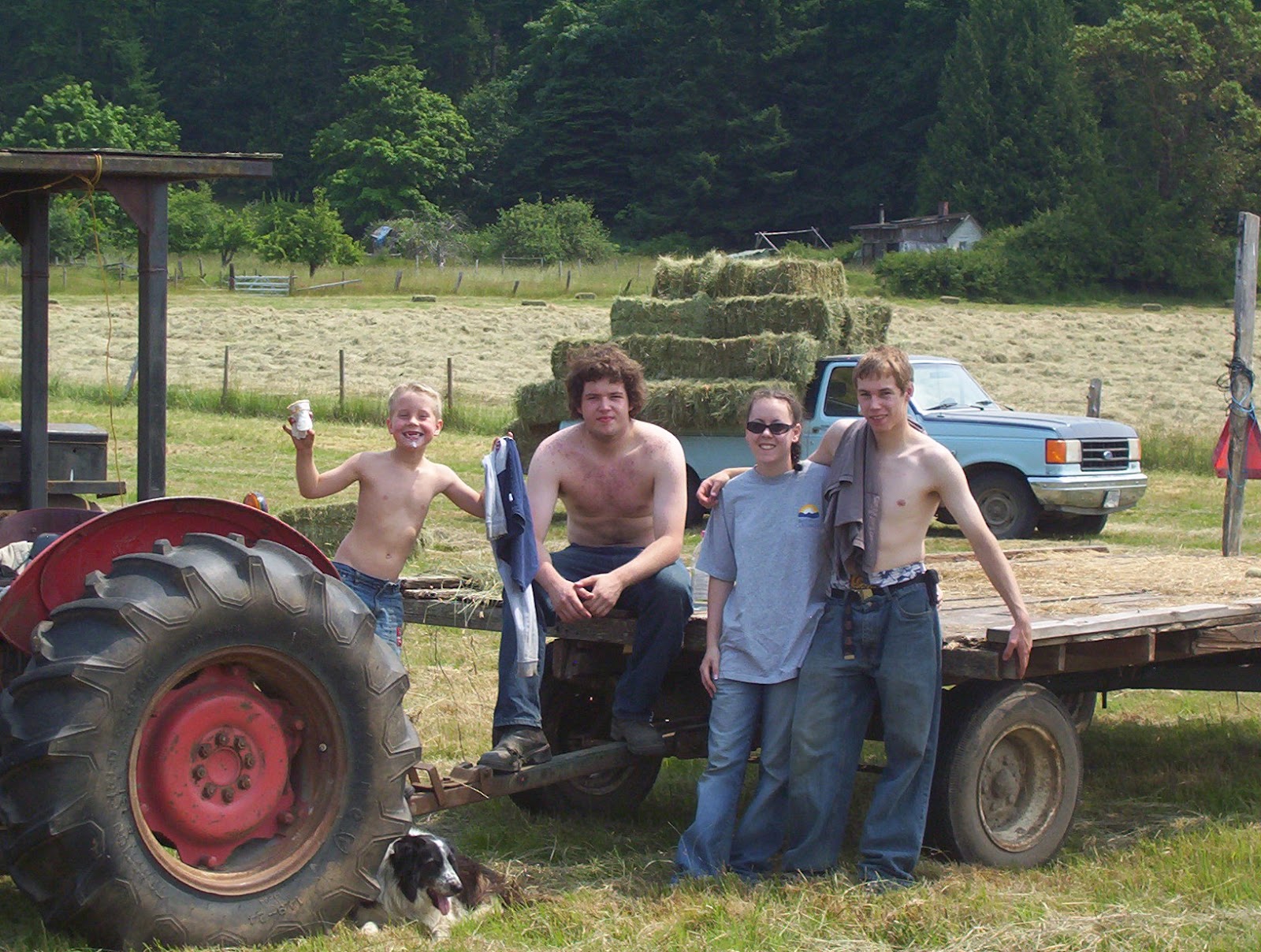 |
| the crew |
The
farmer has an eye on the weather at this time, hoping for warm rains
to help the grass grow, and warm stretches of dry sun just at the
time of cutting, curing, raking and baling. Only comedy is more
reliant on timing and perception than farming. Then again, maybe
they are about the same in that respect. Because if you don’t hit
it all just right, nobody is laughing. There is no rest or
celebrating until the last bale is in the barn. Hopefully, none
of it was rained on. Hopefully, none of the equipment broke down in
the process. Once the hay is all in, the farmer should have enough
hay to last six months. Part of having a sustainable farm is being
able to produce and store your own feed for your own livestock so
they can enjoy their own “100 mile diet” year round.
 |
| the whole family pitches in |
All
of this takes a lot of work, and is a central activity of many farms.
So how is it that in the past couple of years I have heard that
producing hay is not really farming? What is a farm and what is
farming? We all know it is a place where food, fibre and perhaps
flowers are grown or raised or produced. Sometimes farms are
subsistent and produce only for the residents of the farm. Sometimes
farms are very productive, supplying food to many people who do not
farm at all. Many types, sizes and definitions. So how is producing
hay not really farming? Perhaps people who think this do not
realize that hay is just one step removed from the beef or lamb on
your plate.
Bryce
Rashleigh of Central Saanich makes a living producing hay on his own
and other’s land. He keeps state of the art equipment, employs
7-10 people a year, and prides himself on being a very good farmer.
He believes that hay farms are keeping the land in farming until the
economics of farming improve. There is good demand for hay in these
parts. Many small farmers do not have the land base or capital to
grow their own hay, so they must buy it from someone who does, or
have someone like Bryce cut their hay for them. Farmers will grow
what they can sell. If you see land in hay and not “food” such
as carrots or beans, think about what might be behind this. Bryce
and many other farmers blame the global supermarket on the cheap food
and labour that Canadian farmers have to compete against. In the
west we have an overabundance of food from all over the world in our
supermarkets. If the consumer bought local food, or requested the
supermarket to source out and carry local produce, there would be the
demand to encourage more local vegetables and fruits to be produced
here. Otherwise, farmers will just keep growing what they can sell.
With predictions that global food production will have to double by
the year 2030 to meet the escalating demand for food, maybe rising
food prices and higher transportation costs will drive up the price
of imported food, making locally produced foods more competitive.
“Farming
looks mighty easy when your plow is a pencil and you're a thousand
miles from the corn field.”
Dwight
D. Eisenhower
Subscribe to:
Posts (Atom)