|
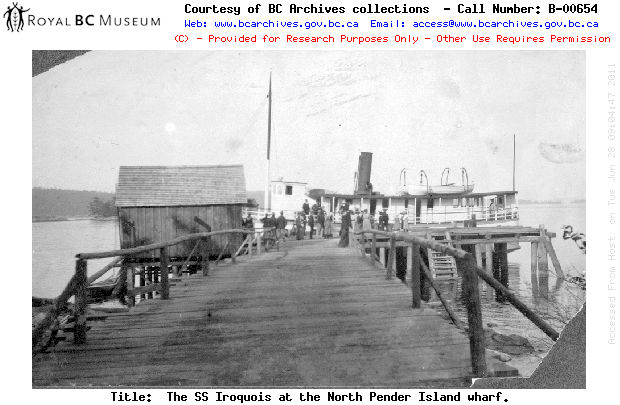
| SS Iroquois at Pender Island |
In days past, people who lived in the Gulf Islands took whatever work they could find. Almost everyone farmed, hunted, or fished and to round out their income they would log, trap, work at sawmills, fish plants, stone-work or labour at a brick factory. Regular ferry service was not yet a reality, so barges and steam ships would be used to move people and products around the waterways.
The Coast Shale Brick Company was established on North Pender Island in 1912, and didn't last long but some of the bricks are still on the beach of Bricky Bay, to be played with by children. Some of the bricks are in the gardens of islanders, forming walkways and garden walls. Other islands had brick factories also, and Gabriola had one of the longest operating brick factories in the Gulf Islands. The Dominion Shale Brick and Sewer Pipe Company began back in the 1890's and was incorporated in 1911. It produced millions of bricks each year until 1952. The bricks were made of blue and brown shale, plentiful in the Gulf Islands. Shale was dug and blasted out of the hillsides, crushed, ground to a fine powder, mixed with water, and formed into their shapes with hydraulic presses. There was no electricity in the early days in the islands so the factories would use steam pumps and boilers. Bricks would be dried and kiln-fired, cooled down and loaded onto wheelbarrows to be taken to the beaches to load on barges.
 |
| Taylor's sandstone quarry on Saturna |
 |
| Boulder Hotel in Gastown built with Pender Island sandstone |
The Gulf Islands were also noted for sandstone. Sandstone was quarried throughout the islands in the mid to late 1800's. The rough-hewn stones from here are in many of the prominent buildings in Vancouver and Victoria, but the demand was reduced in the 1920's and the depression shut down many businesses and factories throughout the region. The earliest sandstone quarry was on Newcastle Island, which supplied the San Francisco US Treasury Mint its dimension blocks in 1873. The BC Penitentiary in 1875, Esquimalt Graving Dock in 1880, Lord Nelson School in 1911 and Christ Church Cathedral in 1955 were built from Newcastle sandstone. Saturna sandstone was primarily quarried at the Taylor farm and the stone there was used for the Carnegie Library in Victoria, Hatley Park House, the Bank of British North America, and the New Westminster Post Office. In 1901 the Boulder Hotel in Gastown used Pender Island sandstone exclusively for its outer walls. One sandstone quarry was at Hope Bay, and another near the bridge between North and South Pender Island, and one or both are the most likely source of the sandstone. The hotel stands today, and sandstone from the islands are in many of the hotels, banks and public buildings that are still in use. The granite and sandstone quarry at the bridge was owned by Mortimer’s Monumental Works Ltd. of Victoria, and the name lives on at Mortimer Spit. Gabriola Island had one of the longest operating sandstone quarries, and the sandstone was also used to produce milling stones that were used in the pulp industry.
Logging was also a primary industry in most Gulf Islands and there are still pockets of old growth trees that give us a glimpse of what the islands used to look like. Trees would be dragged to low bank beaches and towed to the big mills in log booms. Some would be chopped into firewood to fuel the steam ships. The most arable land would have rocks picked, fences built and crops planted. Fruit trees did well in the Gulf Islands, and the location on the main shipping route between Vancouver Island and the mainland was advantageous. People who lived here worked hard and were resourceful and independent, not unlike many of the working islanders today. Many of today's working islanders also are used to working two, maybe three jobs at a time to make ends meet. Some things don't change.
 |
| Taylor's sandstone house remnant - now in Gulf Island National Park Reserve on Saturna |
 |
| Stonework of Taylor house, Saturna |
Some of the old industries are still alive, as local craftsmen mill the beams for your house from local trees someone else selectively logged, or build your rock wall from local sandstone. There has been a resurgence in demand for sandstone and granite from the islands. The Hardy Island Granite Quarry which originally operated in the early 1900’s was reopened in 1999. Granite from Hardy Island was used for the steps and paths of the Olympic Village, and new methods of cutting veneers of rock make these building materials easier to work with, more durable and competitive in comparison to the artificial stones.